
What Happens If Your Site
Fails a Soakaway Test?
A poor result is useful evidence. What it means, which alternatives to investigate and why a test report is not the same as a drainage submission.
- Author
- Jamie Hopcraft, Flowcraft Groundworks Ltd
- Category
- Soakaways & Surface Water
- Published
- Published
If water drains away too slowly during a soakaway test, the next step is to review the result and the drainage proposal. It does not automatically mean the development cannot proceed, but the proposed way of managing rainwater may need to change.
This guide concerns surface-water infiltration testing for roofs and paved areas. Foul-water percolation testing for a septic tank or treatment-plant drainage field has a different purpose.
For homeowners, architects and developers, a poor result is useful evidence. It helps avoid committing to a soakaway before the ground has been shown to accept the expected runoff.
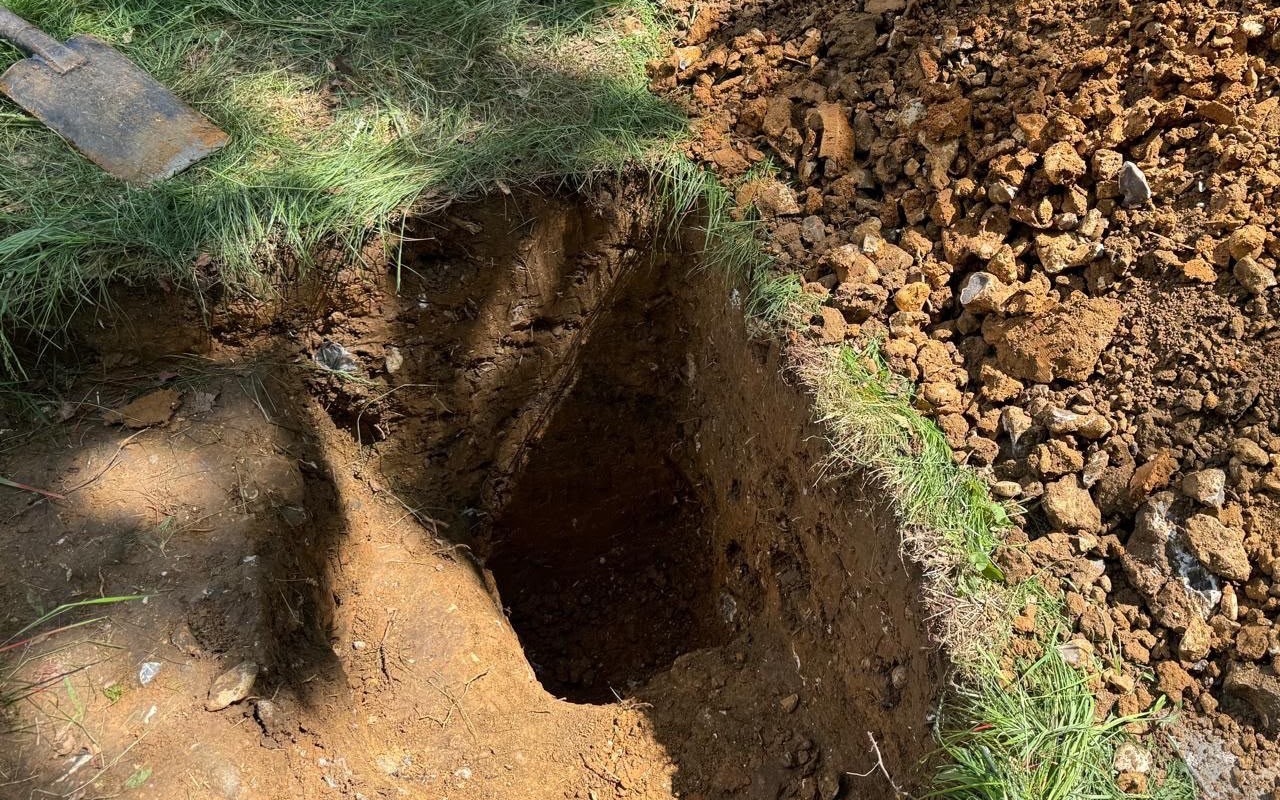
What does a failed soakaway test actually mean?
“Failed” is often shorthand for an unfavourable result. A BRE 365 investigation provides evidence for design, including an infiltration rate where the measurements allow one to be calculated. BRE Digest 365 explains how trial-pit measurements inform soakaway design.[1]
The problem might be a very slow rate, insufficient water-level fall during the monitoring period, groundwater, or another site constraint. The report should identify the actual finding and any limits on the conclusion.
Ask whether the result rules out the proposed arrangement, whether the evidence is incomplete, or whether further assessment is justified. These are different starting points for the next stage.
Review the evidence before choosing another system
The person reviewing the test should be able to understand:
- Where the test took place and how that relates to the proposed soakaway
- The pit dimensions, depth and ground encountered
- The water-level measurements and monitoring times
- Which fillings were completed and any limitations
- Whether groundwater was observed
- The calculated rate, or why a reliable rate could not be obtained
An assumed favourable rate should not be substituted because the measured result makes the design difficult. Equally, a short observation of standing water should be described accurately rather than presented as a completed test.
Keep the records and photographs even if infiltration appears unsuitable. They explain why the original proposal needs to be reconsidered.
Would a larger or deeper soakaway solve it?
Soakaway crates provide storage. They do not change the permeability of the surrounding soil.
A larger system may be worth assessing where infiltration is slow but usable. It still needs a design showing that runoff can be stored and dispersed appropriately. Enlarging a pit without that assessment can simply create a larger volume of standing water.
Digging deeper is also a design decision. Any alternative depth must be assessed for groundwater, ground stability, pollution risk and the levels needed to connect the drainage.
Another location may warrant testing where there is a sound reason to expect different ground conditions. The proposed system must then be based on evidence representative of its actual location and depth.
What alternatives can be considered?
For new development in England, national SuDS guidance prioritises rainwater reuse, followed by infiltration, then discharge to surface water, a surface-water drainage network and finally a combined sewer. The choice requires evidence; proximity to a ditch or sewer does not establish an acceptable connection.[2]
Depending on the site, the design review could consider:
Reducing runoff through rainwater reuse and suitable surface design
A basin, pond or tank with a controlled discharge
Permeable paving designed with storage and a suitable outlet
A combination of features that manage water across the site
A storage tank holds water temporarily. Where infiltration cannot empty it, the design needs another viable route for the water to leave. A pond or basin also needs an appropriate water balance, outlet or infiltration arrangement.
The receiving system, levels, capacity, permissions and future maintenance all need checking. A nearby ditch should never be assumed to solve the problem simply because it is visible.
Does a poor result prevent planning approval?
A poor infiltration result alone does not decide the planning application. The issue is whether a suitable surface-water strategy can be demonstrated and accepted.
Keep the distinction between a test report and the full drainage submission clear. Depending on the proposal, a submission may also need drainage drawings, runoff calculations, storage details, levels, overflow routes and maintenance arrangements.
A drainage submission can be rejected because information is missing or inconsistent even where the ground itself has not failed an infiltration test. Read the decision notice and drainage consultee's comments before deciding what to commission next.
Hertfordshire's flood authority has, for example, raised separate concerns about missing infiltration evidence, unclear drainage layouts, calculations and an unsecured discharge route within the same planning response. That illustrates why testing alone may not resolve every objection.[3]
What should you do next?
Send your drainage adviser the test report, site plan, proposed roof and paved areas, existing drainage information and any planning comments.
The next task is to establish what is known, what remains uncertain and what decision the evidence needs to support. This may lead to targeted further testing, investigation of an alternative outlet or revision of the drainage strategy.
Avoid ordering crates, tanks or excavation on the assumption that a particular solution will be accepted. Agree the design and relevant approvals before committing to the installation.
Frequently asked questions
Can a soakaway work in clay soil?
Clay often limits infiltration, but the site needs assessment. Ground can vary with location and depth. Soil description alone is not a substitute for suitable evidence about the proposed system.
Should I repeat the test until it passes?
No. Further testing should resolve a specific uncertainty or assess a realistic alternative location or depth. Results should be reported honestly, including unfavourable findings and incomplete tests.
Is a failed soakaway test the same as a blocked soakaway?
No. Testing assesses infiltration at a proposed location. An existing soakaway may also perform poorly because of silt, blocked pipework or damage. Soakaway investigation helps establish what is wrong before replacement is recommended.
Will a test report discharge my planning condition?
Only if it satisfies the condition and the planning authority accepts the submission. Some conditions require a wider drainage design as well as testing. Check the exact wording and any reasons given for an earlier refusal.
Discuss the next step with Flowcraft
Flowcraft provides percolation and infiltration testing, soakaway investigation and drainage consultancy across Hertfordshire, Buckinghamshire and Bedfordshire.
Send us the site address, test information and relevant plans or planning comments. We can review what further investigation is needed and agree the scope before providing a quotation.
Email jamie@flowcraft.uk or use the enquiry form to discuss your drainage requirements.
Related Services
If this guide has answered the question you came with, these are the services it leads to.
Related Guidance
Related guides from the Flowcraft Knowledge Centre.
About the author
Jamie Hopcraft
Jamie Hopcraft is the director of Flowcraft Groundworks Ltd and has more than 20 years of practical experience in drainage, groundworks and below-ground investigations.
Poor Soakaway
Test Result?
Send us the site address, test information and relevant plans or planning comments. We can review what further investigation is needed and agree the scope before providing a quotation.