
Knowledge Centre · Soakaways & Surface Water

What Is a French Drain?

Author
Jamie Hopcraft, Flowcraft Groundworks Ltd
Category
Soakaways & Surface Water
Published
Published

A French drain is a trench filled with free-draining stone, usually containing a perforated pipe, that collects water from the surrounding ground or surface and carries it towards a suitable outlet. It can help with localised waterlogging, but its success depends on where the water comes from and where it can go. [1, 2]

The term describes a drainage arrangement, not a guaranteed cure for a wet garden. Before installing one, establish whether the problem is trapped rainfall, runoff from higher ground, a leaking pipe or an existing drain that has stopped working.

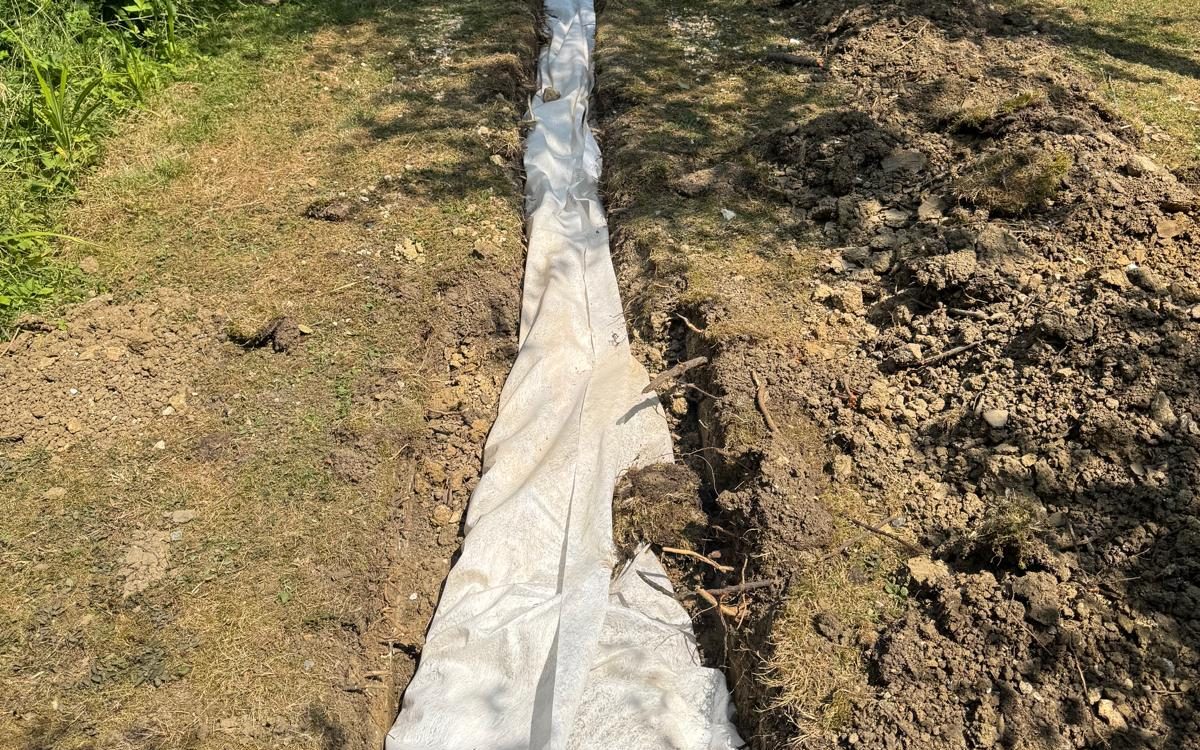
Open drainage trench across a lawn, lined with white filter fabric and not yet backfilled
A drainage trench on one of our jobs, lined with filter fabric and not yet backfilled.

How does a French drain work?

Water enters the spaces between the stones. Where a perforated pipe is included, water can enter through the openings in the pipe and flow along it towards the discharge point. A suitable filter layer helps keep surrounding soil out of the drainage material.

Three parts of the arrangement need to work together: water must be able to reach the trench, move along it and leave it. A blocked outlet or a trench positioned away from the source can leave the original wet area unchanged.

Some designs also allow water to soak into the surrounding soil. That is only useful where the ground can accept it. A filter trench that conveys water onwards and an infiltration trench that disperses it into the ground have different design purposes. [3, 4]

Is a French drain the same as a land drain?

A French drain is a form of land drainage. In UK usage, “land drain” is a broader term and is also commonly used for the perforated pipe itself or a network of buried drains. The names overlap. A specification should explain the construction, depth, purpose and outlet rather than rely on the name alone. [1, 2]

Where can a French drain help?

A French drain may be useful where water can be intercepted along a particular line: for example, at the foot of a garden slope or alongside a path where water collects. Its position should follow the evidence of water movement.

Consider a lawn that becomes wet where water runs down from higher ground. Intercepting that flow before it spreads across the lawn may be useful if there is a suitable discharge route. If the same wet patch is caused by a broken water pipe, the priority is to locate and repair the leak. These are different problems even though both produce standing water.

A single trench will not necessarily drain a whole garden. Compaction, surface levels and the ability of water to move through the soil affect how much of the surrounding area it can serve. Read our guide to why gardens flood after heavy rain for the wider investigation. [2]

Will a French drain work in clay soil?

It can help collect and carry water away in clay soil where water can reach the trench and there is a usable outlet. It does not make the surrounding clay freely permeable. Water may move through the soil so slowly that areas between drains remain wet.

If the proposal relies on the collected water soaking back into the same poorly draining ground, adding gravel or a larger pipe will not solve that limitation. An infiltration system needs evidence that the receiving ground is suitable. Our guide to a BRE 365 soakaway test explains how surface-water infiltration is assessed. [4]

A high water table can also restrict performance. If groundwater already occupies the trench, or the outlet backs up during wet weather, the system may have little ability to remove additional water. [5]

Where should the collected water go?

The outlet should be established before the trench layout is chosen. Depending on the site, the drainage design may direct water to a suitable infiltration feature or an approved downstream drainage arrangement.

Check the receiving system’s capacity and levels, who owns it, and which permissions are needed. An existing nearby pipe, ditch or stream is not automatic permission to connect. For projects in England, work affecting a watercourse may require consent or a permit from the relevant authority. Requirements differ elsewhere in the UK. [7]

A gravel trench with no effective outlet and little infiltration can fill up and remain full. Making it longer creates more temporary storage, but does not establish how that water will leave.

What should a French drain design include?

A useful proposal should describe:

  • The water being collected, the area served and how water will enter the trench.
  • The route, trench dimensions, pipe arrangement and levels leading to the outlet.
  • The drainage aggregate and filter materials suitable for the ground conditions.
  • How the outlet works, including what happens when the receiving system is full.
  • Access for inspection, maintenance and clearing accessible pipework.
  • The finished surface and how lawns, paving or planting will be reinstated.

A surface gravel strip and a drain buried beneath turf collect water differently. If fast-moving runoff is the problem, the finished surface must let that water enter; covering the collection zone with an unsuitable layer of soil can defeat its purpose. Clean drainage stone and a properly selected filter help limit sediment entering the system. [3]

Depth, pipe size and gradient must suit the job. A standard detail copied from another property can miss a shallow foundation, buried service or outlet that is too high. Excavation planning must address underground services and the stability of nearby walls and buildings. [6]

Can a French drain cure damp beside a house?

It may help where external water is contributing to the problem, but the moisture source needs to be established first. Leaking gutters, defective underground pipes and unsuitable external levels may need different repairs. [5]

Digging beside a building can undermine shallow foundations. A poorly positioned or blocked drain can also hold water against the wall. Work near older buildings needs particular care, including an assessment of foundations and ground conditions. A French drain should not be presented as a universal damp-proofing treatment. [1, 5]

Why do French drains stop working?

Common reasons include sediment clogging the stone or filter, an obstructed pipe or outlet, changes to surface levels, and a receiving system that no longer accepts the flow. Water may also be bypassing the collection trench.

Inspect accessible collection areas and outlets for debris, ponding or erosion, especially after heavy rain. Keep records of the route and maintenance access. If the gravel and filter are clogged, cleaning the pipe alone may not restore performance; the affected material may need cleaning or replacement. [3]

Flowcraft investigates garden flooding and surface-water drainage before recommending work. Where a French drain is suitable, the recommendation should explain what it will collect and how the water will be discharged.
FAQs

Frequently asked questions

Does a French drain always need a perforated pipe?

No. Stone-filled trenches without a pipe are also described as French drains or French ditches. A perforated pipe can provide a defined route for conveying collected water. Whether one is needed depends on the intended function and design; the name alone does not tell you how the drain was built. [1, 2]

Is a gravel border around a house a French drain?

Not necessarily. A gravel border may be decorative or reduce soil splash. To establish whether it provides drainage, check its depth, materials, any buried pipe and where collected water goes. Its appearance at the surface is not enough.

How deep should a French drain be?

There is no single depth suitable for every property. The required collection depth, ground conditions, outlet level, buried services and nearby foundations all affect the design. Digging deeper does not automatically improve performance and can introduce structural or excavation risks. [6]

Can a French drain work without an outlet?

It can disperse water locally only if it is designed for infiltration and the ground can absorb the expected flow. In poorly permeable or already saturated ground, an isolated gravel trench may simply fill up. The disposal route needs to be established before installation. [4]

Is a French drain the same as a soakaway?

No. A French drain generally collects water along a trench and conveys it onwards. A soakaway is designed to store water temporarily and let it infiltrate into suitable ground. A French drain may discharge to a soakaway, but each part must be suitable for the flow and site. [3, 4]

Is a French drain the same as a drainage field for a septic tank?

No. A wastewater drainage field receives effluent from a septic tank or treatment plant and provides further treatment as it disperses through suitable soil. A garden French drain collects excess ground or surface water. They are not interchangeable, and a garden drain is not a substitute for a properly designed wastewater discharge system. [8]

How long should a French drain last?

There is no reliable lifespan that applies to every installation. Ground conditions, sediment entering the drain, materials, outlet performance and maintenance all matter. Recurring waterlogging should prompt an investigation of the cause rather than an assumption that every part needs replacing.

How much does a French drain cost?

The price depends on the route and length, access, excavation, materials, disposal of spoil, reinstatement and the work needed at the outlet. Flowcraft assesses the site and provides a written quotation for the agreed work. A price per metre alone may leave out important parts of the system.

Related Services

Where to go next if you have a waterlogged garden or water collecting beside a building.

About the author

Jamie Hopcraft

Jamie Hopcraft is the director of Flowcraft Groundworks Ltd. His work includes garden flooding and surface-water investigations and drainage installation across Hertfordshire, Buckinghamshire and Bedfordshire.

Hertfordshire, Buckinghamshire & Bedfordshire

Find out whether a French drain is right for your property

If you have a waterlogged garden or water collecting beside a path or building, send Flowcraft the property address, photographs taken during wet weather and a brief description of when the problem occurs.

We can assess the drainage problem, explain the investigation needed and provide a written quotation. Our work covers Hertfordshire, Buckinghamshire and Bedfordshire, including Hemel Hempstead, Berkhamsted, Tring and St Albans.

Call 07908 899417 or email jamie@flowcraft.uk.

Sources and further reading

The sources below explain drainage principles, maintenance and relevant precautions. The permission and wastewater references concern England; local requirements should be checked for work elsewhere in the UK.

  1. [1]SPAB — French drains
  2. [2]RHS — Installing garden drainage
  3. [3]CIRIA susdrain — Filter trenches
  4. [4]CIRIA susdrain — Infiltration trenches
  5. [5]Historic England — Building construction and flood resilience
  6. [6]HSE — Excavation safety
  7. [7]GOV.UK — Permission for work on rivers and watercourses
  8. [8]Environment Agency — General Binding Rules for discharges to ground